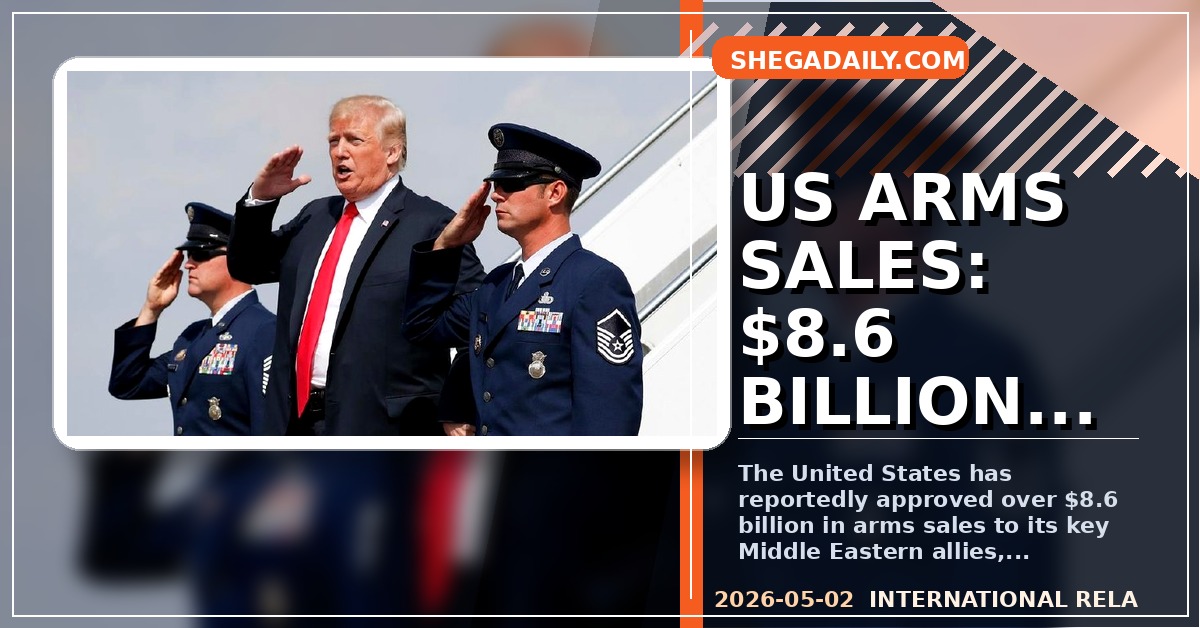
The United States has reportedly approved a substantial package of arms sales, totaling over $8.6 billion, to four of its crucial allies in the Middle East: Qatar, Israel, Kuwait, and the United Arab Emirates (UAE). This significant development, reported on May 2, 2026, underscores Washington's enduring commitment to regional security and its strategic partnerships in a volatile part of the world.
The approved sales are expected to bolster the defense capabilities of these nations, enabling them to address a range of security challenges, from state-sponsored threats to counter-terrorism operations. While the specific types of weaponry included in these deals were not detailed in initial reports, such large-scale agreements typically encompass advanced military hardware, including fighter jets, missile defense systems, precision-guided munitions, and other sophisticated defense technologies.
For Israel, a long-standing strategic partner, these arms sales are consistent with the U.S. commitment to maintaining Israel's qualitative military edge (QME) in the region. This policy ensures that Israel possesses superior military technology to any potential adversaries, a cornerstone of U.S. foreign policy in the Middle East for decades.
Qatar, Kuwait, and the UAE are vital partners in regional stability and counter-terrorism efforts. These Gulf nations host significant U.S. military bases and play crucial roles in various security initiatives, including maritime security and intelligence sharing. The provision of advanced weaponry to these countries is seen as a means to enhance their self-defense capabilities and their capacity to contribute to collective security operations alongside the United States.
U.S. arms sales are a critical component of its foreign policy, serving multiple objectives. They strengthen diplomatic ties, provide leverage in international relations, and support the U.S. defense industry. Furthermore, by equipping allies with modern military assets, the United States aims to deter potential aggressors and promote a balance of power that favors stability and peace.
The process for approving such significant arms deals involves rigorous review by the U.S. State Department and subsequent notification to Congress. Lawmakers have the opportunity to scrutinize and potentially block sales, though this rarely occurs for long-standing allies unless there are significant human rights concerns or strategic objections. The approval of this latest package suggests a broad consensus within the U.S. government regarding the strategic necessity of these transfers.
In a region frequently marked by geopolitical tensions, including ongoing conflicts and rivalries, the infusion of advanced military capabilities can have far-reaching implications. These sales are likely intended to reinforce existing security architectures and reassure allies of continued U.S. support amidst evolving threats. They also signal Washington's intent to remain a primary security guarantor in the Middle East, even as its strategic focus increasingly shifts towards other global priorities.
Ultimately, the over $8.6 billion in arms sales to Qatar, Israel, Kuwait, and the UAE represents a significant investment in the security and stability of the Middle East. It reflects a continuation of U.S. policy to empower its partners, enhance their defensive postures, and safeguard shared interests in a complex and challenging geopolitical landscape.
Source: Telegram / tikvahethiopia